


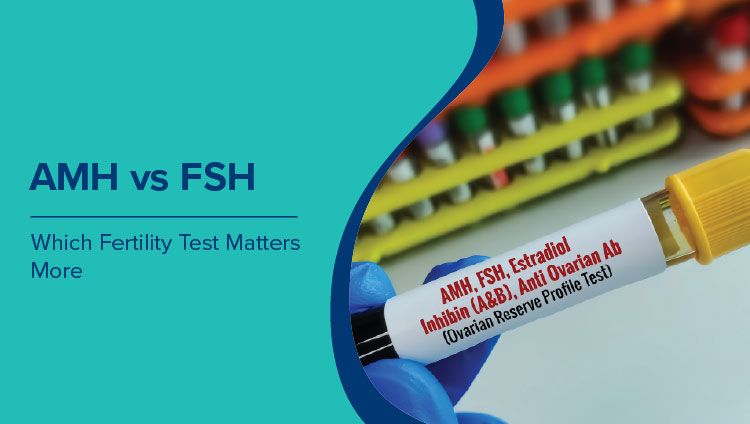


Understanding your fertility can be overwhelming, especially with unfamiliar medical tests and abbreviations. Two key hormone tests often recommended for evaluating ovarian reserve and reproductive health are AMH (Anti-Müllerian Hormone) and FSH (Follicle-Stimulating Hormone).
Although both offer important insights, they measure different aspects of fertility and serve different functions. Understanding how they differ can help you and your doctor select the most appropriate tests or combination to achieve an accurate assessment.
What Is Anti-Mullerian Hormone(AMH)?
A hormone produced by small follicles in the ovaries. These follicles contain immature eggs, so AMH levels reflect your ovarian reserve, or how many eggs you have remaining.
Key Characteristics of AMH Hormone
- Indicates No of eggs in the ovaries(a quantity indicator, not quality)
- Can be tested on any day of the menstrual cycle
- Help plan fertility treatment like IVF
- Relatively stable throughout the menstrual cycle
Limitations: AMH is a quantitative measure; a low AMH does not mean IVF is impossible, especially when egg quality is high. To measure quality, age can be a definitive factor.
What is Follicle-stimulating Hormone(FSH)
The pituitary gland releases this hormone and stimulates the growth of ovarian follicles into mature eggs. FSH level indicates how hard your body is working to stimulate egg production.
Key Characteristics of FSH
- Varies throughout the menstrual cycle.
- For better accuracy, it must be tested on Days 2-4 of the menstrual cycle.
- High FSH may indicate Low ovarian reserve.
- It provides information about ovarian function.
AMH vs FSH: Normal Range Comparison
Understanding what your test results mean is important to analyze your fertility status. Here's a comprehensive comparison of normal ranges:
Note: The ranges may vary depending on the lab condition and testing method; clinical correlation is required
AMH Table interpretation
| Range (ng/mL) | Reserve Status | Clinical Interpretation |
|---|---|---|
| > 4.0 | Very High | Excellent egg reserve; PCOS is common in this range; high IVF success, but risk of overstimulation |
| 1.5 – 4.0 | Optimal/Normal | Ideal reserve for natural conception and fertility treatment; good prognosis |
| 1.0 – 1.5 | Normal-Low | Adequate reserve but declining; consider earlier family planning if desired |
| 0.5 – 1.0 | Low/Diminished (DOR) | Reduced reserve; fertility treatment recommended sooner; may need aggressive protocols |
| < 0.5 | Very Low | Minimal reserve; significant IVF challenges, but pregnancy still possible with tailored treatment |
Key Points
- AMH is a quantitative indicator, not a quality measure; for example, a 42-year-old with AMH of 3.0 may have lower-quality eggs than a 28-year-old with AMH of 1.0.
- Unlike FSH, AMH is stable throughout the cycle and can be tested at any time.
- Doesn't predict natural conception as well as assisted, but it is a better predictor of IVF response than spontaneous pregnancy.
- High AMH (>4-5) often signals PCOS, which requires different treatment strategies.
- The AMH test, along with age, provides a better prognosis (outlook) than either alone.
FSH Table Interpretation.
| Range (mIU/mL) | Reserve Status | Clinical Interpretation |
|---|---|---|
| < 6.0 | Excellent | Optimal ovarian reserve; ovaries respond easily to stimulation |
| 6.0 – 9.0 | Good/Normal | Expected range for most reproductive-age women; normal fertility potential |
| 9.0 – 10.0 | Fair | Upper limit of normal; warrants monitoring but generally adequate |
| 10.0 – 15.0 | Diminished | Reduced ovarian reserve; may require higher medication doses for IVF; success rates begin to decline |
| 15.0 – 25.0 | Poor | Significantly diminished reserve; substantial fertility challenges; pregnancy rates are low |
| > 25.0 | Very Poor | Severely diminished reserve; approaching or in perimenopause/menopause |
Key Points
- Must be measured on days 2-3 of the menstrual cycle
- FSH fluctuates cycle to cycle
- Always carried out alongside other tests, such as AMH, antral follicle count, age, and estradiol levels, to give a fuller picture.
- Age matters a lot; for example, an FSH of 12 at age 25 is more concerning than at age 40.
AMH Vs FSH: Key Differences
Below is a table showing the factors that help clarify the known difference between the two types of hormones.
| Factor | AMH | FSH |
|---|---|---|
| What it measures | Quantity of remaining eggs (ovarian reserve) | How hard the pituitary gland signals the ovaries to produce eggs |
| Testing timing | Any day of the cycle | Day 2-3 of the menstrual cycle |
| Cycle stability | Stable throughout the cycle | Fluctuates during the cycle |
| What do high levels mean | Good/excellent ovarian reserve (possible PCOS if very high) | Poor ovarian reserve; ovaries need strong signals to respond |
| What do low levels mean | Diminished ovarian reserve | Good ovarian reserve; ovaries respond easily with minimal signaling |
| Ideal for | Predicting IVF response, egg freezing decisions, and PCOS diagnosis | Assessing current ovarian function, |
AMH Or FSH: Which Fertility Test Matters More
We cannot say which test is better, as both AMH and FSH assess different fertility factors, and your doctor may recommend one over the other based on your individual circumstances.
Why need AMH
- Predicting IVF response and egg retrieval outcomes
- Making decisions about egg freezing timing
- Convenient testing (can test any day)
- Long-term fertility planning for younger women
Why Need FSH
- To diagnose menopause or premature ovarian failure
- To examine ovarian function
- Evaluating response to fertility treatments
- Traditional fertility assessment protocols
For the most comprehensive understanding of your fertility health, both AMH and FSH tests are ideally needed. They work together: AMH assesses egg quantity, while FSH provides insight into egg quality and ovarian function.
Fertility Test List
Based on an individual's condition and a doctor's careful examination, the following tests may be recommended:
- Anti-Müllerian Hormone (AMH)-Book now
- Follicle-Stimulating Hormone (FSH)-Book now
- Luteinizing Hormone (LH)-Book now
- Prolactin Hormone test- Book now
- Thyroid Stimulating Hormone (TSH)-Book now
- Testosterone level test--Book now
- Estradiol (E2)--Book now
- Fertility Panel- Book now
You can book any of these individually with MAX@Home and combine them as advised by your doctor.
Conclusion
AMH and FSH are not competing tests; they provide complementary information. AMH reflects your remaining egg supply, while FSH indicates the intensity of your body's effort to use those eggs. The most precise understanding of your fertility comes from analyzing the results alongside a clinical assessment.
If you’re planning a pregnancy or concerned about fertility, consult a reproductive specialist who can interpret these tests in light of your age, medical history, and reproductive goals.



 Call: 9240299624

