




Introduction
Ventilator support is a treatment that helps people breathe when they cannot do so well enough on their own. It provides the body with oxygen and removes carbon dioxide, allowing doctors to focus on treating the main health problem. Learning about how ventilators work, when they are needed, and what recovery involves can help patients and families feel less worried and more informed.
What Is Ventilator Support?
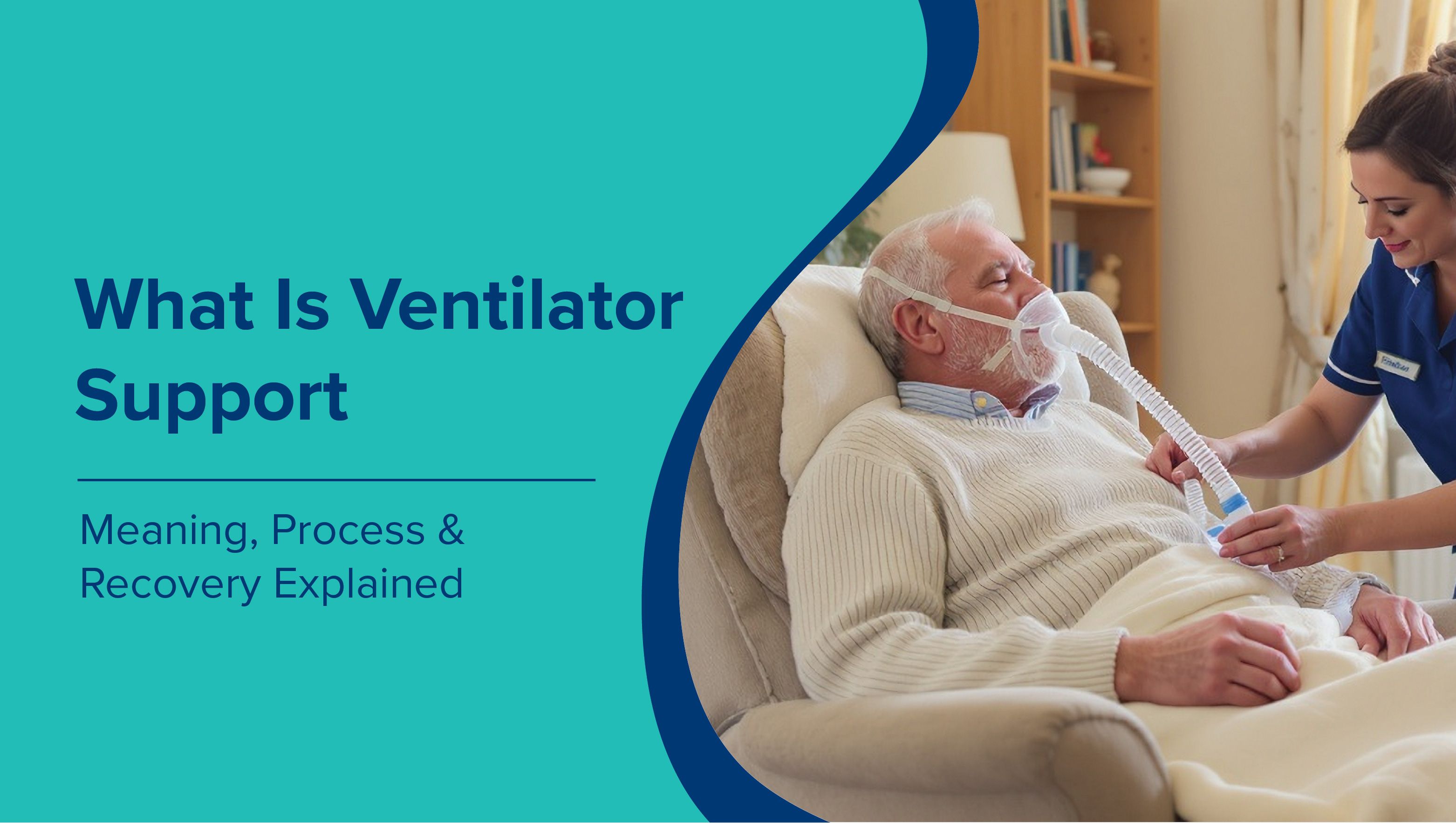
A ventilator, sometimes called a breathing machine or life-support machine, is a device that helps someone breathe if they cannot do so well enough on their own. Ventilator support, or mechanical ventilation, means using this machine to deliver oxygen to the lungs and remove carbon dioxide from the body.
Ventilators are used in hospital ICUs, during surgery in operating rooms, and sometimes at home for people with long-term health problems.
Why Would Someone Need a Ventilator?
Doctors suggest ventilator support when someone cannot maintain safe oxygen levels or breathe on their own. Some common reasons are:
- Respiratory failure: the lungs cannot take in enough oxygen or get rid of enough carbon dioxide
- Pneumonia or COVID-19: severe lung infections that make it hard to breathe
- ARDS (Acute Respiratory Distress Syndrome) — a life-threatening lung condition
- Stroke or brain injury: these can affect the brain’s ability to control breathing
- Drug overdose or poisoning: these can slow down or stop the breathing system
- During major surgery, general anaesthesia can temporarily stop normal breathing.
- asthma attacks — inflammatory airway obstruction (narrowing of the tubes
- Neuromuscular diseases — such as ALS or Guillain-Barré syndrome
Ventilators are not meant to be used forever. They are a tool to help the body recover until it can breathe on its own again.
Types of Ventilator Support
There are different types of ventilator support. They fall into two main groups:
1. Non-Invasive Ventilation (NIV)
This type does not need a breathing tube. Instead, a mask covers the nose and mouth, or just the nose, and air is delivered through it.
- CPAP (Continuous Positive Airway Pressure): gives a steady flow of pressurized air
- BiPAP (Bilevel Positive Airway Pressure): provides different air pressures for inhalation and exhalation.
NIV is used for milder breathing problems and is often given to people with sleep apnea, mild COPD, or early-stage breathing trouble.
2. Invasive Mechanical Ventilation (IMV)
This method uses a breathing tube (endotracheal tube) that goes through the mouth or nose into the windpipe. The ventilator then helps the person breathe through this tube.
If someone needs ventilator support for more than one or two weeks, doctors may do a tracheostomy. This is a small surgical procedure to create an opening in the neck through which a tube is placed directly into the windpipe. It is more comfortable for long-term use.
Quick Comparison Table
| Feature | Non-Invasive (NIV/BIPAP) | Invasive (IMV) |
|---|---|---|
| Interface | Tight-fitting mask | Endotracheal tube or Tracheostomy |
| Sedation | Usually minimal or none | Often required (moderate to deep) |
| Ability to Talk | Possible (but difficult) | Not possible (with a mouth tube) |
| Primary Use | COPD, Sleep Apnea, Pulmonary Edema | Severe Respiratory Failure, Surgery |
How Does a Ventilator Work?
Here is a simple step-by-step look at what happens when someone is placed on ventilator support:
Step 1: Assessment
The medical team checks the patient’s oxygen levels, breathing rate, blood tests, and overall health to decide if ventilation is needed.
Step 2: Sedation (If Invasive)
For invasive ventilation, patients usually get medicine to keep them comfortable and prevent them from pulling at the tube. Sometimes, especially with NIV, patients are kept awake while using the machine.
Step 3: Intubation
A trained doctor, often an anesthesiologist or intensivist, puts an endotracheal tube into the windpipe through the mouth. This usually takes just a few minutes.
Step 4: Ventilator Settings Are Configured
The ventilator is set up with specific settings based on what the patient needs:
- Tidal volume: the amount of air given with each breath
- Respiratory rate: the number of breaths per minute
- FiO2: the amount of oxygen in the air given
- PEEP (Positive End-Expiratory Pressure): A technique that keeps the alveoli (the microscopic air sacs) from collapsing at the end of a breath
Step 5: Continuous Monitoring
The ICU team watches the patient at all times. They check blood oxygen and carbon dioxide levels, heart rate, and blood pressure, and adjust ventilator settings as needed.
Step 6: Weaning
As the patient improves, ventilator support is gradually reduced. This is called weaning. The aim is for the patient to do more of the breathing on their own until they no longer need the machine.
Tests To Monitor Patients on Ventilator Support
When someone is on ventilator support, doctors regularly perform tests to check how well the lungs and other organs are working. These tests guide treatment decisions and ensure ventilator settings are safe and effective.
Essential Monitoring Tests
- ABG (Arterial Blood Gas) - Book now
- CBC (Complete Blood Count) - Book now
- CRP (Inflammation Marker) - Book now
- Electrolytes Panel - Book now
- KFT (Kidney Function Test) - Book now
- LFT (Liver Function Test) - Book now
- Serum Lactate - Book now
Additional Tests (as per doctor's recommendation)
Need urgent tests for a ventilated or recovering patient? Book ICU monitoring tests at home with MAX@Home now.
Is Being on a Ventilator Painful?
Families often ask if being on a ventilator is painful. Usually, it is not, because patients are kept sedated and comfortable.
The breathing tube can be uncomfortable, so sedatives and sometimes muscle relaxants are given. Patients on ventilators are closely monitored for any discomfort, and medications are adjusted as needed.
Patients using NIV masks are usually awake and able to talk, although the mask can become uncomfortable after a while.
How Long Does Ventilator Support Last?
The duration depends entirely on why the patient needs it:
- Post-surgery ventilation: usually just for a few hours until anaesthesia wears off
- Severe pneumonia or COVID-19: can last from days to weeks
- ARDS: usually 1 to 3 weeks, sometimes longer
- Brain injury: last weeks to months, depending on recovery
- Chronic conditions (for example, ALS): may need long-term or permanent home ventilation
There is no set timeline. The medical team works on treating the main problem while the ventilator helps the body.
What Is the Weaning Process?
Weaning means slowly reducing ventilator support as the patient gets better. This is done carefully to prevent any problems.
How weaning works:
- The ventilator is adjusted to give fewer breaths, so the patient can start breathing more on their own.
- Doctors perform Spontaneous Breathing Trials (SBTs), which are short periods during which the patient breathes mostly on their own with minimal assistance.
- If the patient does well during SBTs, the breathing tube is removed. This is called extubation.
- After extubation, the patient may still need extra oxygen through a mask or nasal prongs for some time.
Some people are taken off the breathing tube quickly. Others need more time, especially if they have been on the ventilator for a long time or are older.
Ventilator Support Recovery: What to Expect
Recovery after using a ventilator is different for everyone. Here are some common things people experience:
Physical Recovery
- Weakness and tiredness: muscles can get much weaker during long ICU stays, a problem called ICU-acquired weakness
- Sore throat: caused by the breathing tube, but it usually goes away in a few days.
- Difficulty swallowing: This is common after the tube is removed, and a speech therapist can help
- Breathlessness: This is normal at first and usually gets better with time and physiotherapy
Cognitive & Emotional Recovery
Many people who have been on a ventilator for a long time may have post-intensive care syndrome (PICS), which can include:
- Memory problems or brain fog
- Anxiety, depression, or PTSD
- Sleep disturbances
These effects are real, well-known, and treatable. Many hospitals now offer ICU follow-up clinics to help survivors.
Rehabilitation
Most patients benefit from:
- Physiotherapy to rebuild muscle strength (Book now)
- Respiratory therapy to improve lung function
- Occupational therapy for daily activities (Book Occupational therapy now)
- Speech therapy if swallowing is affected (book now)
- Psychological support for mental health recovery
Recovery may take weeks, months, or even longer. Being patient, having support, and getting rehabilitation can make a big difference.
Ventilator Support With MAX@Home
For people with long-term conditions like ALS, muscular dystrophy, or severe COPD, home ventilation is possible. Home ventilators are small, easy to move, and can be managed by trained caregivers or family members with help from a medical team.
MAX@Home provides safe, hospital-grade ventilator care at home for patients with conditions like ALS, muscular dystrophy, or severe COPD. With portable ventilators, trained medical support, and regular monitoring, patients can receive reliable breathing assistance while staying comfortable at home, reducing hospital visits and improving quality of life.
Key Takeaways
Ventilator support is a powerful, life-saving medical intervention that helps patients breathe when they cannot do so on their own. In most cases, it is a temporary measure intended to give the body time to heal. While the process involves close monitoring, potential sedation, and gradual weaning, many patients go on to recover well with the right medical care and rehabilitation. If someone you care about is on a ventilator, remember that the machine is not a sign of failure. It means that every possible step is being taken to help them recover



 Call: 9240299624

