


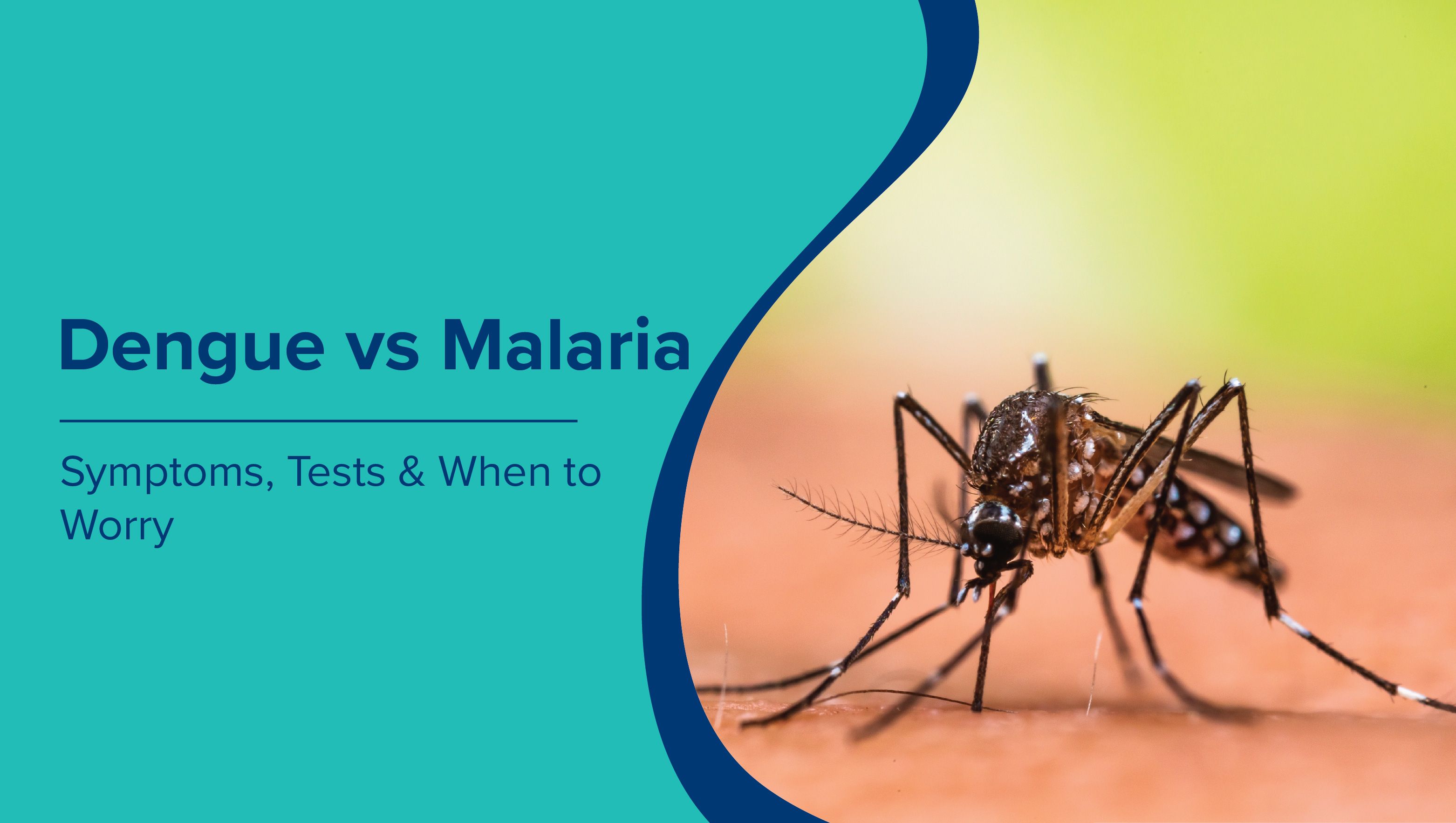


Quick answer: Dengue and malaria are both mosquito-borne fevers, but they come from different mosquitoes and different organisms. Dengue is a virus spread by the day-biting Aedes mosquito, causing high continuous fever, severe body aches, and sometimes a rash or bleeding. Malaria is caused by a Plasmodium parasite spread by the night-biting Anopheles mosquito, causing fever that often comes in cycles with shaking chills and sweating. A blood test is the only reliable way to tell them apart, since early symptoms overlap heavily.
Why Dengue and Malaria Get Confused
If you or someone in your family has developed a sudden high fever, especially during or after the monsoon, dengue and malaria are usually the first two things a doctor will want to rule out. Both are transmitted by mosquitoes and can start with fever, headache, and body pain, and both can range from mild to dangerous within a matter of days. That overlap is exactly why so many people search for the difference between the two, the early symptoms simply do not give a clear answer on their own.
The good news is that the two illnesses come from completely different causes, spread through different mosquitoes, and are confirmed by different tests. Once you understand what to look for and which tests actually confirm each infection, it becomes much easier to know when a fever needs urgent attention.
What Causes Dengue and Malaria
Dengue is caused by the dengue virus, spread through the bite of an infected Aedes aegypti mosquito. This mosquito typically bites during the day, breeds in small pools of clean, stagnant water (flower pots, coolers, discarded tyres), and is most active in urban and semi-urban areas during and just after the rainy season. You can read more detail on this in our dengue fever symptoms and causes guide.
Malaria is a disease caused by the Plasmodium parasite. In India, this is usually Plasmodium vivax or Plasmodium falciparum. It is spread via the bite of the Anopheles mosquito that usually feeds at night and lays eggs in large stagnant water pools like ponds and wet areas. Falciparum malaria is considered more dangerous of the two species and is the one most associated with severe complications.
Dengue vs Malaria: Symptom Comparison
Both illnesses have common symptoms of fever, headache, body pain, and tiredness, which makes self-diagnosis hard. The following table indicates how the two diseases normally differ.
| Feature | Dengue Fever | Malaria |
|---|---|---|
| Fever pattern | High, continuous fever (often 103-105 F), sometimes with a brief dip and rebound ("saddleback" pattern) | Fever in cycles, often every 48 or 72 hours depending on the parasite species, with a clear break in between |
| Chills | Mild chills may accompany initial fever rise | Severe shaking chills (rigors) followed by drenching sweats |
| Body and joint pain | Severe, often described as "breakbone" pain in muscles and joints | Present but usually less intense than dengue |
| Rash | Common, appears 3-5 days into illness, flat red or blotchy | Rare |
| Eye pain | Pain behind the eyes is a classic symptom | Not typical |
| Nausea and vomiting | Common | Common, especially in children |
| Bleeding tendency | Can occur in moderate to severe cases (gum bleeding, nosebleeds, petechiae) | Rare, except in severe falciparum malaria |
| Jaundice | Uncommon | Can occur due to hemolysis and liver involvement, primarily in severe P. falciparum or complicated P. vivax |
| Onset | Sudden, symptoms build quickly over 24-48 hours | Can be sudden or gradual depending on the species |
A fluctuating fever that is cycling between chills and sweating tends to favor malaria. A constant fever with body aches, headache, and a rash tends to be indicative of dengue. However, it is important to note that even if there are certain indications for one disease, the only way to determine the disease is through a blood test.
How Doctors Confirm the Diagnosis
As a result, diagnosis is done using blood tests instead of symptoms due to the similarity between the two infections; sometimes both are tested together since co-infection is possible in endemic areas.
Tests Used to Confirm Dengue
- Dengue NS1 Antigen Test, which can detect the virus as early as day one to day five of fever
- Dengue IgM and IgG antibody tests, which are more useful after the first week of illness
- Platelet count, since a falling platelet count is a key marker doctors track through the illness, explained in detail in our dengue platelet count chart
Tests Used to Confirm Malaria
- Peripheral Smear for Malarial Parasite (MP test), the gold-standard microscopy test that identifies the exact Plasmodium species present
- Malaria Antigen Test (rapid diagnostic test), which gives a faster result and is useful when microscopy isn't immediately available
Shared Baseline Tests
In addition to the mentioned tests above, the Complete Blood Count (CBC) is also done to examine the levels of white blood cells, haemoglobin, and platelets. Crucially, Hematocrit (Packed Cell Volume - PCV) is monitored as a primary marker for assessing plasma leakage and Dengue Shock Syndrome (DSS), in addition to tracking platelet counts. When the reason for fever remains unknown, a comprehensive fever profile test is advised as it tests the presence of both infections alongside other common causes of fever.
When to Worry: Warning Signs You Should Not Ignore
Both dengue and malaria will most likely be cured if proper treatment and adequate rest are provided. However, both diseases can become dangerous very fast; knowing the warning signs matters more than knowing the exact diagnosis in the moment.
Dengue Warning Signs
- Severe abdominal pain or persistent vomiting
- Bleeding from the gums, nose, or in the urine or stool
- Cold, clammy skin or restlessness
- A sudden drop in fever accompanied by worsening symptoms (this is often when the critical phase begins, not when the patient is recovering)
- Rapid, sharp fall in platelet count alongside a rising hematocrit level; this combination is a critical indicator of hemoconcentration and plasma leakage requiring rapid IV fluid management and immediate clinical attention
For a full breakdown of these red flags, see our detailed guide on warning signs of dengue fever.
Malaria Warning Signs
- Confusion, drowsiness, or seizures (signs of possible cerebral malaria)
- Difficulty breathing
- Yellowing of the skin or eyes (jaundice), often indicating hemolysis or hepatic involvement
- Very low urine output
- Severe anaemia or extreme paleness
If any of these signs appear, or if fever is not improving within 2-3 days of starting treatment, this is not the time to wait it out at home. A same-day doctor visit at home can help assess severity and decide if hospital-level monitoring is needed.
Treatment: How the Approach Differs
There are no antiviral drugs available to cure dengue infection. The treatment involves resting, hydration, and checking the platelet count along with the symptoms. Paracetamol is administered for the fever and pain, while NSAIDS like ibuprofen and aspirin are not prescribed since they may increase the risk of internal bleeding.
Malaria, by contrast, does have specific antimalarial medication, and the choice of drug depends on the Plasmodium species identified on the smear test and how severe the infection is. This is one of the biggest practical reasons an accurate diagnosis matters; treating malaria like dengue, or vice versa, means the patient doesn't get the medication they actually need.
Prevention: Different Mosquitoes, Different Habits
Because the two mosquitoes behave differently, prevention strategies overlap but aren't identical.
- Drain and decontaminate stagnated water from coolers, flower pots, and other containers to prevent breeding of Aedes (dengue)
- Use mosquito nets and mosquito repellents, particularly from dusk to dawn to avoid getting bitten by Anopheles mosquitoes (causes malaria)
- Wear full-sleeved shirts during the mosquito period, both in daytime and at night
- Use window and door screens and indoor residual spraying in case of malaria-prone areas.
- If travelling to a malaria-endemic region, ask your doctor about preventive antimalarial medication in advance.
Fever That Won't Settle? Get Tested at Home.
Noticed a high fever with chills, body pain, or a rash that hasn't improved in a day or two? Don't guess which one it is. MaxAtHome's trained phlebotomists collect your blood sample at home, with reports from NABL-accredited labs.
Book a Fever Test at HomeRelated Support
Frequently Asked Questions
Can you have dengue and malaria at the same time?
Yes, co-infection is possible in areas where both mosquitoes are common, though it's uncommon. This is one reason doctors often test for both when the cause of fever isn't obvious.
Which is more dangerous, dengue or malaria?
Both can become severe if untreated. Malaria, especially Plasmodium falciparum, can progress to organ failure or cerebral malaria. Dengue can progress to plasma leakage, bleeding, and shock. Neither should be treated as "the mild one."
How soon can a dengue or malaria test detect the infection?
NS1 test for dengue is capable of detecting infection starting from day one after the onset of fever. The malaria smear test is able to detect malaria parasites starting when the symptoms appear although retesting might be required in some cases.
Does dengue always cause a rash?
No. A rash appears in many but not all dengue cases, usually a few days into the illness. Its absence doesn't rule dengue out.
Why does malaria fever come and go?
The cyclical pattern reflects the life cycle of the Plasmodium parasite inside red blood cells, which rupture at regular intervals, releasing the parasite and triggering fever and chills each time.
Can a normal blood test miss malaria?
There may be a chance that one peripheral smear could fail to detect the presence of a very small infection; hence, doctors may want to perform another smear after 12-24 hours.
Is home blood collection reliable for dengue and malaria tests?
Yes. What matters is that the sample is collected correctly and processed in a NABL-accredited lab, both of which MaxAtHome's home collection service is built around.
When should I see a doctor instead of just resting and monitoring at home?
If fever crosses 102-103 F for more than two days, if warning signs like bleeding, confusion, or breathing difficulty appear, or if a child, elderly person, or pregnant woman is affected, a doctor visit shouldn't be delayed.
References
- World Health Organization. Dengue and severe dengue
- World Health Organization. Malaria
- Centers for Disease Control and Prevention (CDC). Dengue
- Centers for Disease Control and Prevention (CDC). Malaria
- National Center for Vector Borne Diseases Control (NCVBDC), Ministry of Health & Family Welfare, Government of India. Dengue Situation in India

 Call: 9240299624

