


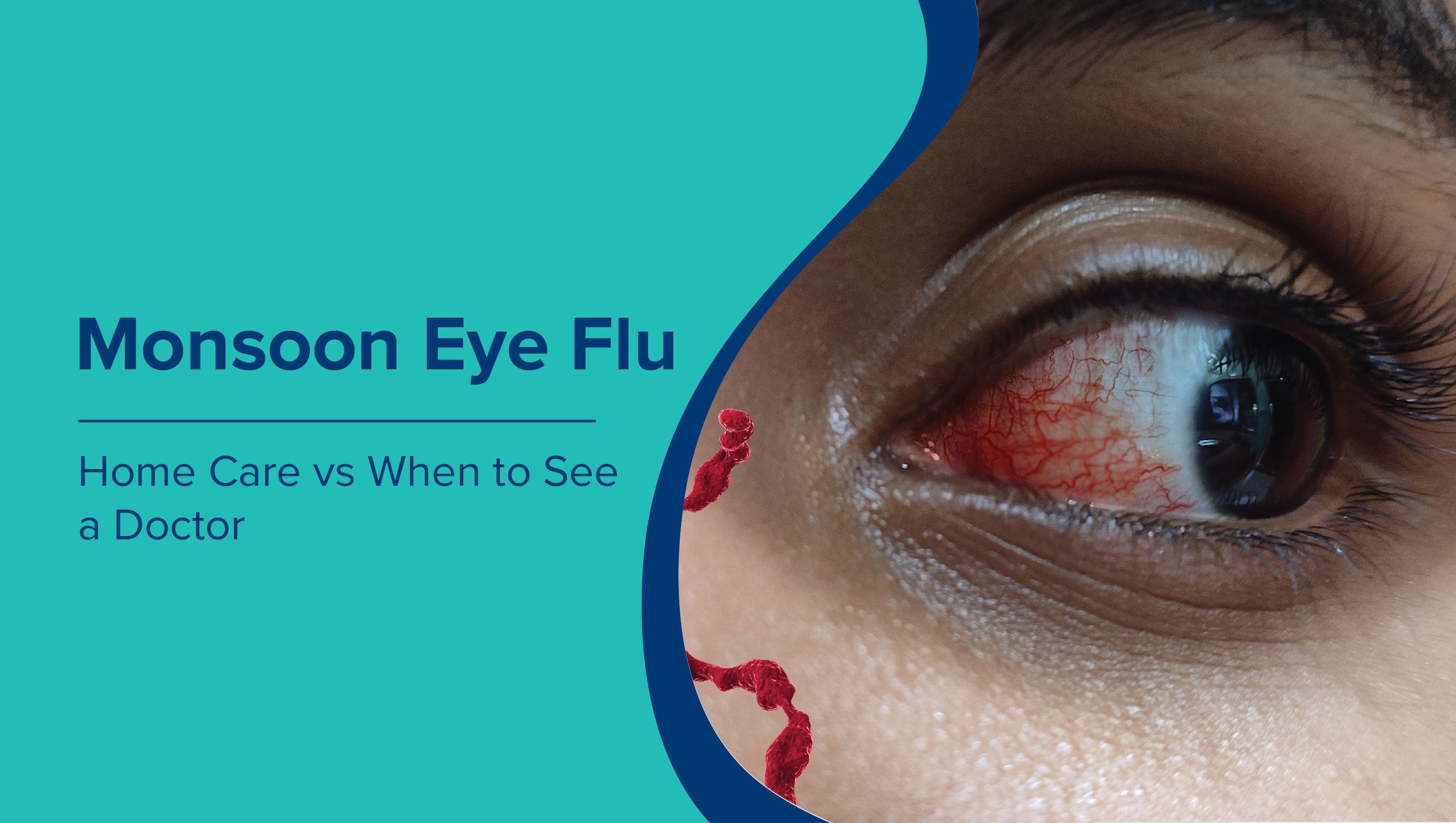


Monsoon brings the same worry to homes and workplaces every year: red, watery eyes spreading through a household, a school, or an office within days. Eye flu (conjunctivitis) is inflammation of the thin, clear membrane covering the white of the eye and inner eyelid, usually caused by a virus or bacteria, and humidity and waterlogging create ideal conditions for it to spread during the monsoon months. This guide breaks down what causes monsoon eye flu, how to tell it apart from other eye conditions, safe home care, and the exact point at which self-care stops being enough.
Quick answer: Most monsoon eye flu is viral, resolves in 7–10 days with home care such as cold compresses and strict hygiene, and doesn't need antibiotics. But if you notice severe pain, vision changes, high fever, or symptoms in a newborn, don't wait it out — get a doctor's evaluation at home rather than self-medicating with leftover eye drops.
What Is Eye Flu (Conjunctivitis)?
Conjunctivitis, commonly called “eye flu” or “pink eye,” happens when the conjunctiva — the transparent tissue lining the eyelid and covering the white part of the eye — becomes inflamed. The inflammation makes tiny blood vessels in the eye more visible, giving the eye its characteristic pink or red appearance. There are three main types, and telling them apart matters for treatment:
| Type | Cause | Discharge | Spreads Easily? |
|---|---|---|---|
| Viral conjunctivitis | Adenovirus (most common in monsoon outbreaks) | Watery | Yes, highly contagious |
| Bacterial conjunctivitis | Bacteria (e.g., Staphylococcus, Streptococcus) | Thick, yellow-green, sticky | Yes, contagious |
| Allergic conjunctivitis | Pollen, dust, mold, humidity-related allergens | Watery, stringy | No, not contagious |
Note: Viral conjunctivitis is responsible for most of the seasonal “eye flu” outbreaks reported across Indian cities during monsoon — a confirmed diagnosis of the exact type always requires a clinical eye examination.
Why Eye Flu Spikes During Monsoon in India
Several monsoon-specific conditions make conjunctivitis outbreaks more common between July and September: waterlogging and contaminated water increase contact with disease-causing viruses and bacteria, especially in flood-prone urban pockets; high humidity allows viral particles to survive longer on surfaces like door handles, towels, and mobile phones; crowded, damp environments such as classrooms, offices, and public transport speed up person-to-person transmission; and shared personal items like towels, kajal, and spectacles are a common but overlooked source of spread within households. Outbreaks often cluster in a specific geographical location and then spread from there to an entire housing society, workplace, or school within days.
Symptoms of Monsoon Eye Flu
Watch for a combination of these signs, usually starting in one eye and spreading to the other within a day or two:
- Redness in the eyes (white part) or inner eyelids
- Watery or thick discharge, depending on the underlying cause
- Burning sensation in the eyes
- Swelling of the eyelids, especially in the morning
- Increased light sensitivity
- Caked eyelashes, especially overnight
- Slight blurring of vision that resolves after blinking or wiping away discharge
Symptoms typically appear 24–72 hours after exposure and peak within the first 3–5 days.
Home Care for Eye Flu: What Actually Helps
Most viral and mild bacterial conjunctivitis cases can be managed at home. These steps help you recover faster and protect people around you:
- Cold compresses — a clean, damp cloth held gently over closed eyes for 5–10 minutes several times a day reduces swelling and discomfort.
- Wipe discharge with fresh cotton — use a new piece of cotton or tissue for each eye, each time, and discard it immediately.
- Avoid touching or rubbing your eyes — this is the single biggest driver of spread and self-reinfection.
- Wash hands frequently, especially after touching your eyes or face.
- Don't share towels, pillowcases, or eye makeup with anyone during the infection.
- Skip contact lenses until symptoms fully resolve and a doctor confirms it's safe to continue.
- Avoid swimming pools and crowded places while discharge or redness is present, to prevent spreading it further.
- Don't self-medicate with leftover eye drops, especially steroid-containing ones — these can worsen certain infections and, in rare cases, damage the eye if the cause is misidentified.
Over-the-counter lubricating eye drops (artificial tears) can ease dryness and irritation without needing a prescription, but antibiotic or steroid drops should only be used if a doctor prescribes them for your specific case.
When Home Care Isn't Enough: Warning Signs to Watch For
Go for a doctor immediately if you notice any of the following:
- Severe pain in the eye (mild irritation is normal; sharp or worsening pain is not)
- Change in vision that doesn't clear with blinking
- Intense light sensitivity that makes it hard to keep eyes open
- High fever alongside eye symptoms
- Thick, continuously recurring yellow-green discharge (suggests bacterial infection needing antibiotics)
- Eye flu in a newborn or infant — always needs same-day medical attention
- One eye affected in someone with a compromised immune system, diabetes, or a history of eye surgery
Note: In these situations, a doctor visit at home may include a clinical eye examination, and occasionally a conjunctival swab test to identify whether the cause is viral, bacterial, or something else — this changes the treatment completely, since antibiotics don't work on viral conjunctivitis.
Eye Flu vs Other Monsoon Eye Conditions
Not every red, watery eye during monsoon is conjunctivitis. It's worth ruling out dry eye aggravated by AC or fans (redness without much discharge, worse by evening), a corneal abrasion or foreign body (sudden sharp pain, often after dust or an insect near the eye), a stye or hordeolum (localized swelling and tenderness at the eyelid margin, not spread across the whole eye), or an allergic reaction to monsoon mold or pollen (intense itching, both eyes together, often with sneezing). If symptoms don't match the typical conjunctivitis pattern, or if they're one-sided with sharp pain, a doctor's evaluation is the safer route.
Not Sure If It's Eye Flu or Something Else? Get Checked
Don't guess when redness or discharge won't settle down. A doctor can examine your eyes at home, confirm whether it's viral, bacterial, or allergic, and prescribe the right treatment — without you stepping out while contagious.
Book a Doctor Visit at Home →Related Support From MAX@Home
- Doctor Visit At Home — Get a clinical eye examination without stepping out while you're contagious.
- Monsoon Fever Profile-Basic — Recommended if eye flu symptoms come with fever, since dengue, malaria and typhoid also spike this season.
- Comprehensive Allergy Panel Test — Useful if your doctor suspects an allergic rather than infectious cause.
- Common Allergy Symptoms & Tests You Shouldn't Ignore — For ruling out allergic conjunctivitis.
- Dengue Fever: Symptoms, Causes & Prevention — Another common monsoon health concern,Read now
Conclusion
Monsoon eye flu is uncomfortable and highly contagious, but for most people it's a short-lived, manageable illness — cold compresses, clean hands, and avoiding shared items are usually all that's needed to recover within 7 to 10 days. What matters is recognising the point where home care isn't enough: severe pain, vision changes, high fever, or symptoms in a newborn are reasons to see a doctor immediately rather than wait it out. With a doctor visit at home from MAX@Home, getting the right diagnosis doesn't mean risking spreading the infection further by stepping outside.
Frequently Asked Questions
How long does monsoon eye flu last?
People with viral conjunctivitis recover within 7–10 days on its own. Bacterial conjunctivitis often improves within 3–5 days of starting antibiotic drops. If symptoms persist beyond two weeks, see a doctor.
Is eye flu contagious, and how does it spread?
Yes, viral and bacterial conjunctivitis are both contagious. They spread through direct contact with eye discharge, contaminated hands, shared towels or makeup, and sometimes through coughing or sneezing if a respiratory virus is also involved.
Can I go to work or school with eye flu?
It's advisable to stay home while there's active discharge and redness, generally the first 3–5 days, to avoid spreading it to others. Many schools and offices in India request a few days off during confirmed eye flu outbreaks.
Do I need antibiotic eye drops for eye flu?
Not always. Antibiotics only help bacterial conjunctivitis. Viral conjunctivitis, which is more common in monsoon outbreaks, resolves on its own and doesn't respond to antibiotics — using them unnecessarily can contribute to antibiotic resistance.
Can eye flu affect vision permanently?
In the vast majority of cases, no, conjunctivitis resolves without any lasting effect on vision. Rare complications can occur if it's left untreated or misdiagnosed, which is why persistent or severe symptoms need medical evaluation rather than prolonged home care.
Is there a test for eye flu?
Diagnosis is usually clinical, based on a doctor's eye examination. In recurring, severe, or unclear cases, a conjunctival swab can be sent for testing to confirm whether the cause is viral, bacterial, or allergic.

 Call: 9240299624

