


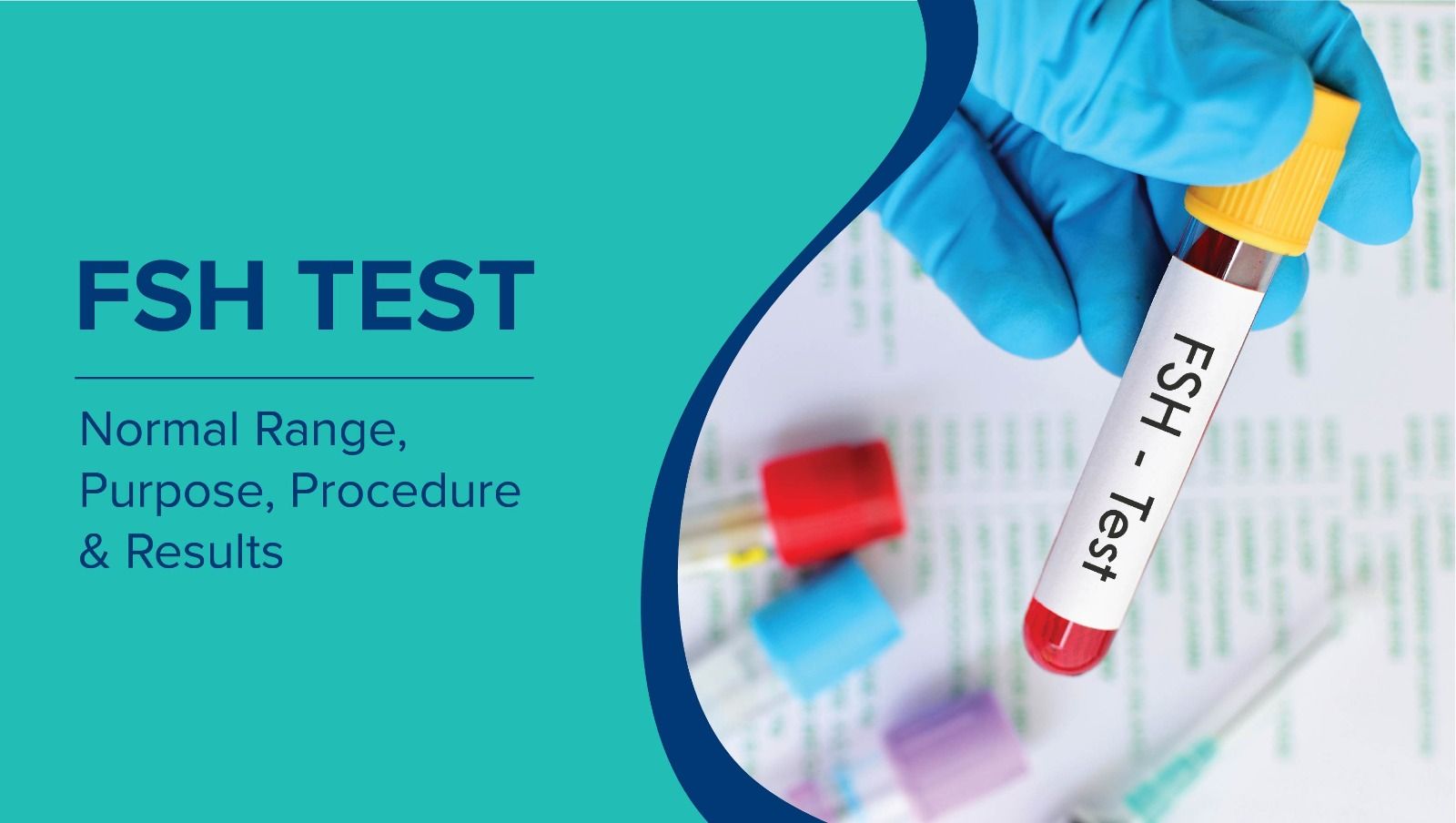


Quick Answer: The FSH (follicle-stimulating hormone) test is a blood test that measures the FSH hormone released by the anterior pituitary that helps eggs grow in women and sperm form in men. The normal FSH range for an adult woman who still has periods is about 4.7 to 21.5 mIU/mL, and for an adult man it is about 1.5 to 12.4 mIU/mL. After menopause, normal levels range from 25.8 to 134.8 mIU/mL. Doctors use the test to look into fertility problems, irregular periods, menopause and puberty concerns.
Irregular periods, trouble conceiving, or symptoms that look like early menopause?
Get FSH tested along with LH, prolactin, AMH and the rest of the hormone panel, with free home sample collection and digital reports.
Book a Hormone Test at Home →What Is the FSH Test?
FSH stands for follicle-stimulating hormone, released from the pituitary, a small gland at the base of the brain, makes it. To measure the level of this hormone, a blood test known as a follicle-stimulating hormone test is done to measure the level of this hormone in your blood.
Note: FSH has nothing to do with hair follicles or hair growth. It acts on the small sacs in the ovaries that hold developing eggs.
What is the Role of FSH
This Hormone plays a different role in both genders,with the most important role in women during ovulation; in mens it supports fertility
Women
In women, FSH tells the ovarian follicles to grow and mature an egg each month. It also helps control the menstrual cycle. FSH rises in the first half of the cycle to help follicles mature, and a surge of another hormone, LH, around the middle of the cycle triggers ovulation.
Men
In men, FSH works with testosterone to support sperm production in the testicles. That is why it is part of the check when a couple has trouble conceiving and the man's sperm count is low.
Why a Doctor Recommends an FSH Hormone Test
The main purpose of an FSH hormone test is to determine whether the ovaries or testicles are working properly and whether the signal from the pituitary gland and the brain is normal. The reason differs by age and sex.
| Who | Common reasons for the test |
|---|---|
| Women | Trouble getting pregnant, irregular or missing periods, abnormal bleeding, suspected early menopause, possible polycystic ovary syndrome (PCOS), or menopause-like symptoms with no clear cause |
| Men | Trouble getting a partner pregnant, low sperm count, low sex drive, or signs of low testosterone |
| Women and men | Suspected pituitary gland problem |
| Children and teens | Puberty that seems too early or too late |
FSH Test for Men
In men, the FSH test is usually done with testosterone and sometimes with thyroid and prolactin tests, along with a semen analysis. A high FSH can mean the testicles are not making sperm properly. A low FSH can point to a problem higher up, in the pituitary gland or the brain.
FSH and LH Test Together
FSH is rarely read alone. Doctors often order it with LH (luteinizing hormone), and sometimes with estradiol, progesterone or testosterone. The pattern across these hormones tells the doctor much more than one number can.
Who May Not Need the Test
Women aged 45 or older with typical menopause symptoms usually do not need an FSH test to confirm menopause. Doctors often diagnose menopause based on symptoms and changes in periods. Your doctor will tell you whether the test adds anything in your case.
FSH Test Normal Range
Normal FSH values depend on age, sex and, in women who have periods, the point of the cycle. The ranges below are commonly used reference values in mIU/mL, which is the same as IU/L.
| Stage of life | Females (mIU/mL) | Males (mIU/mL) |
|---|---|---|
| Before puberty | 0 to 4.0 | 0 to 5.0 |
| During puberty | 0.3 to 10.0 | 0.3 to 10.0 |
| Adult (women who have periods) | 4.7 to 21.5 | Not applicable |
| Adult men | Not applicable | 1.5 to 12.4 |
| After menopause | 25.8 to 134.8 | Not applicable |
The values may differ based on the lab condition and techniques used Always refer to your doctor before following this table
In women who still have periods, FSH is lowest around the start of the cycle and rises as the follicles mature, which is why the day of the test matters.
FSH Levels in Females and Infertility
FSH levels in females are one way doctors estimate ovarian reserve, the remaining supply of eggs. A high FSH early in the cycle can suggest the ovaries are not responding as well as they should, which can happen with ovarian failure or perimenopause. Very low FSH can mean the brain and pituitary gland aren't sending the right signal for eggs to develop.
For basic fertility testing, doctors often check FSH on day 3 of the cycle, counting the first day of your period as day 1. In one study of IVF patients, a day 3 FSH below 15 mIU/mL was linked with better pregnancy chances than levels of 15 to 24.9, and levels above 25 were linked with lower chances still.
Still, FSH is only one piece. Doctors may look at it alongside another hormone called AMH (anti-mullerian hormone) Test, an ultrasound, a day 23 progesterone test to check ovulation, and tests for the tubes and the uterus. A single FSH report does not tell you whether you can or cannot get pregnant.
When to Get Tested for Fertility
- You have been trying to get pregnant for 12 months without success
- Your periods are irregular, very far apart or have stopped
- Your partner has a low sperm count, or your doctor advises testing both partners
- You are under 45 and have symptoms that look like early menopause
High FSH Levels: Causes and Symptoms
High FSH usually means the ovaries or testicles aren't responding properly, so the pituitary gland keeps sending more of the hormone to push them. High FSH levels in women are most often a sign of menopause, which is normal after the mid-forties.
Menopause before age 45 is called early menopause, and before age 40 it is called premature menopause. If your periods stop before 45, see a doctor rather than assuming it is nothing.
Causes of High FSH Levels in Women
1. Perimenopause and Menopause
In the years leading up to menopause, the ovaries gradually slow down. FSH rises sharply during this time and keeps rising through the transition.
2. Premature Ovarian Insufficiency (POI)
Some women reach this stage before the age of 40. The ovaries stop responding properly much earlier than expected, and a high FSH is often one of the first clues.
3 Fewer Eggs Left in the Ovaries
As the egg supply (ovarian reserve) shrinks, the brain tells the pituitary gland to send out more FSH to keep the ovaries working. The ovaries have less to respond with, so FSH keeps climbing.
4. Genetic or Inherited Conditions
Some conditions affect how the ovaries develop, long before a woman notices anything. Turner syndrome and Fragile X premutations are two examples that can stop the ovaries from working normally and push FSH up.
5. Surgery on the Ovaries
With less ovarian tissue, there is less for FSH to act on. After partial or complete removal, the pituitary keeps signalling to a smaller ovary, or none at all.
6. Autoimmune Condition
In some autoimmune disorders, the body mistakenly attacks ovarian tissue. The damage builds up silently, and many women only find out when they start trying to conceive.
7. Chemotherapy and Radiation
Cancer treatment can seriously harm the ovaries. The effect depends on the type of treatment, the dose and the area treated, and FSH can stay high long after treatment is over.
Causes of High FSH Levels in Men
1. Testicular Failure
When the testes can’t make enough sperm, the body raises FSH to try to boost production.
2. Genetic Conditions
Some genetic disorders affect how the testes form from the very start. The high FSH often shows up years after the damage has happened.
3. Testicular Injury or Infection
A serious injury or infection can do more than cause short-term pain. Sperm-producing tissue doesn’t always recover fully, and FSH tends to rise as a result.
4. Varicocele
Enlarged veins in the scrotum can disturb the conditions the testes need to work well. Not every varicocele causes trouble, but in some men it can upset hormone balance.
5. Cancer Treatment
Radiation and chemotherapy attack fast-dividing cells, and sperm-making cells are among them. The treatment that clears the cancer can affect fertility, sometimes permanently.
Symptoms of High FSH level in Men and Women
An abnormal FSH does not cause symptoms by itself. The symptoms come from the condition behind it, so you may need an FSH test to diagnose the condition
In Women
Symptoms of high FSH in women often include:
- Irregular or missed periods
- Hot flashes and night sweats
- Dryness in the vaginal region
- Difficulty conceiving (related to pregnancy)
- Mood swings
- Unable to sleep properly
In Men
- Reduced fertility(may be due to low sperm count)
- Feeling very low or tired every day
- Libido(low sexual drive)
- Reduced testicular size(in some cases)
- Erectile dysfunction
The Symptoms may differ and doees not confirm the condition related to abnormal FSH levels in blood, a clinical correlation is always required
FSH Test Procedure and Preparation
The FSH test is a routine blood draw from a vein in the arm. It takes a few minutes, and you may feel a brief sting.
How to prepare
- No special preparation is usually listed for this test, but follow any instructions given with your booking
- If you have periods, ask your doctor which day of the cycle to test. Day 3 is common for fertility testing
- Tell the doctor about any hormone medicines, birth control, chemotherapy or recent radiation
- Carry your earlier reports if you have had hormone tests before
What Happens During the Test
- A phlebotomist cleans the skin on your arm and ties a band above it.
- A blood sample is collected from a vein using a small needle.
- The phlebotomist removes the band and needle and covers the site with a cotton pad or bandage.
- The sample goes to the lab, and they share the report with you.
Note: You may have some pain, bruising or throbbing at the site. Fainting, a blood collection under the skin and infection are less common.
FSH Blood Test Cost
The cost of an FSH blood test depends on the lab, the city and whether you book it alone or as part of a package. It is often cheaper as part of a hormone or fertility panel than if you book each test separately, and home sample collection may add a small charge in some places.
- Test alone or in a panel: FSH is often bundled with LH, estradiol, prolactin, thyroid tests or AMH
- Home collection: check whether a collection fee applies
- Report time: ask how soon the report comes, especially if you are timing the test to a cycle day
- Accreditation: look for a lab that follows quality standards and shows the reference range on the report
For the current FSH price in your city, check the top healthcare brand like MAX@Home team when you book.
How to Read Your FSH Report
- Check your group. Compare your number with the range for your age and sex, as shown on your own report.
- Note the cycle day. For women with periods, an FSH value means little without knowing which day the blood was drawn.
- Look at the other hormones. LH, estradiol, testosterone and AMH, if tested, give the full picture.
- Do not self-diagnose. A single high or low value does not confirm menopause, infertility or a pituitary problem.
- Talk to your doctor. Bring your report, your symptoms and your history, and ask whether to repeat the test.
Book an FSH Test at Home with MAX@Home
If you would rather not travel for a blood test, MAX@Home offers at-home pathology tests, where a trained phlebotomist collects the sample, and the report is sent to you. If your result is abnormal, you can also arrange a doctor visit at home to go through it.
Book an FSH Test at Home →Confirm with MAX@Home when booking: the FSH price in your area, the cycle day to book for, and when the report will be ready.
A Quick Overview Table Before Your FSH Test
| Step | What to do | Done |
|---|---|---|
| Doctor | Know why the test is advised and which hormones go with it | ☐ |
| Timing | Women with periods: confirm the cycle day (often day 3 for fertility) | ☐ |
| Medicines | Tell the doctor about hormone medicines, birth control or cancer treatment | ☐ |
| Reports | Keep older hormone reports to compare | ☐ |
| Booking | Confirm the price, home collection and report time | ☐ |
| After | Take the report to your doctor; do not self-diagnose | ☐ |
People Also Ask
What is the normal range for the FSH test?
In women who have periods, normal FSH is about 4.7 to 21.5 mIU/mL, and after menopause it is 25.8 to 134.8 mIU/mL. In adult men it is about 1.5 to 12.4 mIU/mL. Ranges differ slightly between labs, so use the range printed on your own report.
What is the purpose of the FSH test?
The FSH test checks how well the ovaries or testicles and the pituitary gland are working. Doctors use it to look into infertility, irregular periods, suspected menopause, low sperm count, pituitary problems, and early or delayed puberty in children. It is usually read along with LH and other hormones.
What does a high FSH level mean in a woman?
High FSH in a woman usually means her ovaries aren't responding well. The most common reason is menopause, which is normal in midlife. In younger women it can point to early menopause, primary ovarian insufficiency or other conditions. Your doctor will read it alongside your symptoms and other hormone tests.
What causes low FSH levels?
Low FSH usually means the pituitary gland or hypothalamus isn't sending enough signals. In women it can also happen with being very underweight, rapid weight loss, extreme exercise, not ovulating or pregnancy. A doctor may order more tests to find the cause before suggesting treatment.
Can FSH levels tell if a woman can get pregnant?
No. FSH levels in females help estimate ovarian reserve, but they are only one factor in fertility. Doctors also consider AMH, an ultrasound, ovulation, the tubes and the uterus, and tests of the male partner. A single FSH value cannot confirm or rule out pregnancy.
On which day of the period should the FSH test be done?
For basic fertility testing, doctors often advise day 3 of the cycle, counting the first day of your period as day 1. FSH changes through the month, so the timing matters. Always ask your doctor which day suits your situation before booking.
Do men need an FSH test?
Men may need an FSH test when a couple has trouble conceiving and the sperm count is low, or when there are signs of low testosterone, such as low sex drive or loss of muscle or body hair. It is usually done with testosterone and a semen analysis.
Is the FSH test always done with the LH test?
Not always, but often. LH is the most common companion test because the two hormones work together. Doctors may also add estradiol, progesterone or testosterone. Reading these together gives a clearer picture than FSH alone, especially for fertility and pituitary problems.
How much does an FSH blood test cost?
The cost of an FSH blood test depends on the lab, the city, whether it is booked alone or as part of a hormone panel, and whether home collection is included. Panels are often better value than separate tests. Check the current price on the booking page or ask the lab before you book.
Do I need an FSH test to confirm menopause?
Often not. Women aged 45 or older with typical symptoms usually do not need an FSH test, as menopause is diagnosed from symptoms and the change in periods. The test is more useful if you are under 45 and your periods have changed or stopped. Ask your doctor.
Conclusion
The FSH test is a simple blood test, but the number only makes sense when you know your age, your sex, the day of the cycle and the other hormones next to it. A high or low result is a clue for your doctor to follow, not a verdict.
If you are trying to conceive, have irregular periods or are worried about early menopause, talk to your doctor about whether an FSH test is the right place to start, and bring the report along to the visit.
Related Tests and Reads
References
MedlinePlus (National Library of Medicine). Follicle-stimulating hormone (FSH) blood test: https://medlineplus.gov/ency/article/003710.htm
MedlinePlus (National Library of Medicine). Follicle-stimulating hormone (FSH) levels test: https://medlineplus.gov/lab-tests/follicle-stimulating-hormone-fsh-levels-test/
Cleveland Clinic. Follicle-stimulating hormone (FSH): https://my.clevelandclinic.org/health/articles/24638-follicle-stimulating-hormone-fsh
Eunice Kennedy Shriver National Institute of Child Health and Human Development (NIH). How is infertility diagnosed?: https://www.nichd.nih.gov/health/topics/infertility/conditioninfo/diagnosed
Mayo Clinic. Primary ovarian insufficiency: https://www.mayoclinic.org/diseases-conditions/premature-ovarian-failure/symptoms-causes/syc-20354683
NHS. Early menopause: https://www.nhs.uk/conditions/early-menopause/



 Call: 9240299624

