


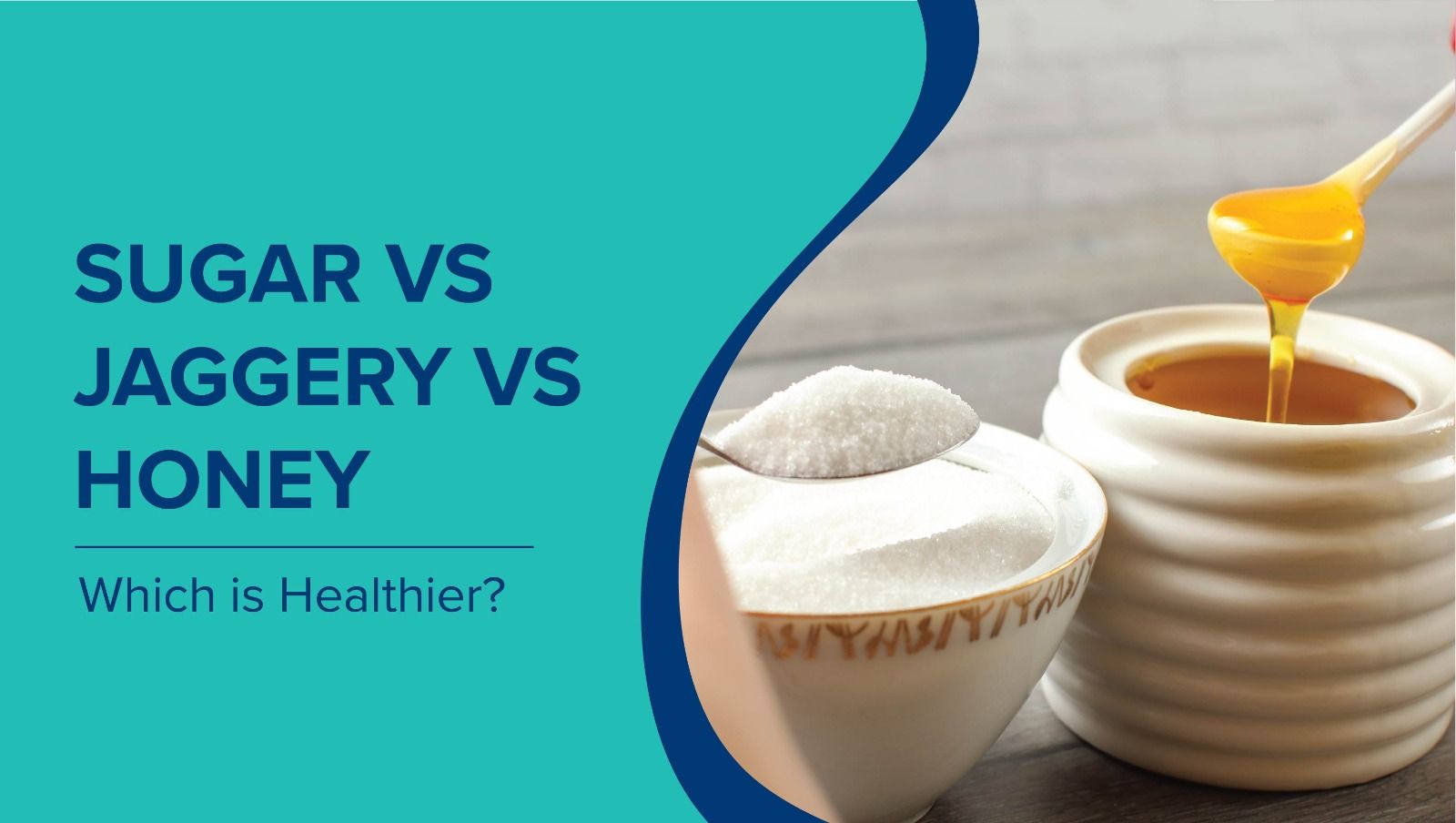


Quick Answer: Sugar, jaggery and honey are all added sugars that raise blood glucose and add calories. Jaggery has traces of minerals, and honey has a slightly lower glycemic index, better than the others, so the real goal is to use less of all three with proper guidance from your nutritionist or dietician.
Want to know how sugar is affecting your blood glucose?
Book an at-home HbA1c test and see your 3-month average blood sugar from the comfort of home.
Book HbA1c Test →Sugar vs Jaggery vs Honey: A Quick Comparison
Here is a quick comparison given below in the table format. Figures are approximate because they vary with the brand, the source, and how the product is made.
| Sugar | Jaggery | Honey | |
|---|---|---|---|
| Made from | Sugarcane or sugar beet, refined | Boiled sugarcane juice or palm sap, unrefined | Nectar processed by bees |
| Main sugars | Sucrose | Mostly sucrose, some glucose and fructose | Fructose and glucose |
| Calories per 100 g | About 390 to 400 | About 380 to 390 | About 300 to 330 |
| Calories per teaspoon | About 16 to 20 | About 15 to 20 | About 20 to 22 |
| Minerals | Almost none | Small amounts of iron, magnesium, potassium | Tiny traces |
| Glycemic index | About 60 to 70 | Reported values vary; often close to sugar | About 45 to 65, depending on type |
| Extra benefits | None | Minor mineral content | Some antioxidants |
| Counts as free sugar? | Yes | Yes | Yes |
What Is Refined Sugar?
Table sugar (Chini) is sucrose that has been extracted from sugarcane juice, then purified, crystallized, and bleached until it's pure white. Almost everything except the sugar is removed, so what you get is energy without vitamins, minerals or fibre. That's why nutrition experts call it "empty calories."
You will see a few cousins of white sugar. In india for example Khandsari, or desi khand is a less refined crystal sugar. Mishri is a rock sugar made by crystallising sugar solution. Brown sugar is usually white sugar with molasses added back for colour. They taste a little different, but nutritionally they're still mostly sucrose.
What Is Jaggery (Gur)?
Jaggery is made by boiling sugarcane juice, or the sap of date or palm trees, until it thickens and sets into blocks or powder. Because it isn't spun and bleached the way sugar is, it keeps a little of the molasses, which gives it that dark colour and earthy flavour. Palm jaggery, date jaggery and sugarcane jaggery are the common types in India, and each region has its favourites.
Jaggery is still mostly sucrose, usually somewhere between 65% and 85%, with smaller amounts of glucose, fructose and minerals. It's less processed than sugar, which is nice, but less processed doesn't automatically mean healthy.
What Is Honey?
Honey is made by bees from flower nectar. It's mostly fructose and glucose with about 17% water, plus small amounts of enzymes, organic acids and plant compounds that act as antioxidants. The exact mix depends on the flowers the bees visited, which is why a litchi honey, a mustard honey and a multiflora honey can differ in taste, colour and even blood sugar effect.
Honey is sweeter than sugar, so some people use less of it. But it's also thicker and denser, so a spoonful carries a similar or slightly higher number of calories than a spoonful of sugar.
Calories and Nutrition: Sugar vs Jaggery vs Honey
All three are mainly carbohydrates with almost no protein or fat. Per 100 g, sugar gives roughly 390 to 400 calories, jaggery about 380 to 390, and honey about 300 to 330, because honey contains water. But nobody eats 100 g. Per teaspoon, the differences nearly vanish, which is why swapping one for another rarely changes your calorie intake.
Jaggery is often praised for its iron, magnesium and potassium. It does contain more than white sugar, and the amount varies by how it's made. But at the 5 to 10 g people actually use in tea or a sweet, you'd get only a small fraction of what an adult needs in a day. You'd have to eat a lot of jaggery to make a real difference, and by then the sugar load would outweigh any mineral benefit.
Honey has a few vitamins and minerals in trace amounts and some antioxidants, mostly flavonoids and phenolic acids. These are interesting to researchers, but again the quantities in a spoonful are small.
Glycemic Index of Sugar, Jaggery and Honey
The glycemic index (GI) measures how quickly a food raises blood glucose. White sugar has a GI of around 60 to 70, which is medium to high. Honey is often lower, commonly around 45 to 65, though it varies a lot by floral source and processing. Reported values for jaggery are inconsistent between studies, and many place it close to sugar or even higher.
So honey may have a slight edge on GI. But GI isn't the whole story. Glycemic load, which also takes the portion into account, matters more in daily life. A large spoon of a "lower GI" honey can still push blood sugar up more than a small amount of sugar. All three are quickly absorbed, and none can be called a low-GI or diabetes-friendly food.
Is Jaggery Healthier Than Sugar?
Jaggery contains small amounts of minerals that white sugar lacks, and it's less processed. That's about where the advantage ends.
Calories are nearly identical. Blood sugar impact is almost similar. And jaggery still counts as free sugar, which can cause weight gain and tooth decay the same way sugar does.
It is seen that some commercial jaggery is treated with chemicals to make it look bright and golden. Darker, plainer jaggery from a trusted source is generally the better choice.
Is Honey Healthier Than Sugar?
Honey tends to have a lower glycemic index and is sweeter; it can also soothe a cough in adults and children above one year because of its thick nature. It forms a protective layer over the affected tissues, so a spoonful in warm water is a harmless comfort for a sore throat.
But honey is still a free sugar with plenty of calories. Eating a lot of it will affect weight and blood sugar just as sugar does. Take care of two things before consuming. First, honey should never be given to babies under 12 months, because of the risk of infant botulism.
Second, adulterated honey is a known problem in India, with sugar syrups sometimes mixed in, so buy from a trusted brand or source rather than assuming "natural" on the label means pure.
What Do ICMR-NIN and WHO Say About Sugar, Jaggery and Honey?
This is the part many people miss. India's Dietary Guidelines released by ICMR-NIN in 2024 state that refined sugar, jaggery and honey are all sugars, and none is superior to the others. The guidelines advise keeping added sugar below about 5% of daily energy, which works out to roughly 25 to 30 grams a day for most adults, and say that ideally added sugar would be avoided altogether where possible. They also caution against relying on artificial sweeteners as a long-term replacement.
The WHO takes a similar line. Its 2015 guideline recommends keeping free sugars below 10% of total energy, with a further reduction to below 5% for additional benefit. Importantly, WHO's definition of free sugars includes the sugars naturally present in honey and syrups, not only table sugar.
In plain terms: whichever sweetener you choose, the total amount matters far more than the type.
Sugar, Jaggery or Honey for Diabetes
If you or a family member has diabetes, the question "is jaggery good for diabetes?" or "can diabetics eat honey?" comes up constantly. The safe answer is that none of the three is a free pass. Jaggery for diabetes and honey for diabetics both raise blood glucose, sometimes about as fast as sugar, and they should be counted as part of the daily carbohydrate allowance.
Some people with diabetes may be advised to have a very small amount occasionally, as part of a meal rather than on an empty stomach. That should be decided with your doctor or dietitian, based on your blood sugar control and medicines. Don't swap sugar for jaggery or honey thinking it's safer, and don't use them to treat low sugar unless your doctor has told you how.
Which Is Better for Weight Loss?
None. Is honey good for weight loss? There's no strong evidence that swapping sugar for honey or jaggery leads to weight loss. Calories per spoon are similar, and extra sugar in any form adds to total energy intake. If you're trying to lose weight, the most effective step is reducing the total amount of sweet foods and drinks, especially sweetened tea, cold drinks, packaged snacks and mithai. A teaspoon less in each cup of chai can add up to a lot over a year.
Sugar, Jaggery and Honey for Children, Pregnancy and Older Adults
Children
- Keep sweets occasional and always tell them to brush their teeth, as sugar feeds cavities causing bacteria
- Sugar, jaggery, and honey all raise the risk of cavities and weight gain.
- Avoid giving honey to babies under 12 months (infant botulism risk).
- Sweet drinks and packaged snacks contain a higher amount of sugar compared to jaggery or honey.
Pregnancy
- No need to avoid sweets completely, but keep total sugar modest.
- If you are at risk of gestational diabetes, consume it only after following your gynecologist's advice.
- Jaggery and honey are not safer swaps. They raise blood glucose too.
- If diagnosed with gestational diabetes, follow your doctor's and dietitian's plan.
Older Adults
- With diabetes, count all three as carbohydrates and agree on the amount with your doctor.
- With high blood pressure, heart or kidney problems, check with your doctor before using jaggery or honey regularly.
- Don't use jaggery or honey as a tonic for weakness or anaemia. Get a blood test instead.
- Brush after sweets, as gum and dental problems are more common with age.
Other Indian Sweeteners: Are They Good?
Khandsari, mishri, date jaggery, palm jaggery and coconut sugar often get marketed as healthier choices. They may be less refined and have slightly different flavours, but they're still mostly sugar and should be used sparingly. Artificial sweeteners and "sugar-free" products are not a clear solution either. ICMR-NIN has raised concerns about long-term, heavy reliance on them, and they can keep the taste for sweetness high. If you have diabetes and are thinking of using them, discuss it with your doctor.
How Much Sugar Is Too Much? Hidden Sugar in Indian Diets
Keeping to approx 25 to 30 grams of added sugar a day sounds easy until you count it up. One level teaspoon of sugar is about 4 to 5 grams, so that's roughly six or seven teaspoons from all sources in the entire day. Here's where it hides:
- Two or three cups of chai with two spoons of sugar each
- A single gulab jamun, jalebi or ladoo, which can hold several teaspoons
- Packaged juices, colas, flavoured milk and energy drinks
- Breakfast cereals, biscuits, cakes and sweetened yoghurt
- Sauces, ketchup and ready-to-eat snacks
- Honey or jaggery added to "healthy" smoothies, oats or health drinks
Sugar from whole fruit and plain milk is different, because it comes with fibre and nutrients and is digested more slowly, so those aren't the target here.
Simple Ways to Cut Down on Sugar, Jaggery and Honey
- Cut a quarter teaspoon from each cup of tea or coffee every week until you're comfortable with less.
- Have a portion control; always keep sweets for festivals and special occasions.
- Swap sweetened drinks for water, jeera water, buttermilk without sugar or plain lemon water.
- Read food labels for "added sugar," and note that names like sucrose, glucose syrup, dextrose, and honey all count.
- Sweeten foods with fruit, such as banana or dates, in small amounts, rather than extra sugar.
- Brush your teeth after sweets, since all sugars feed cavity-causing bacteria.
How to Choose Good Quality Jaggery and Honey
Quality checks are essential, as they will help you to select the good ones among the cheap ones. For jaggery, try to look for darker, plain-looking blocks or powder from a source you trust, and be cautious of very bright yellow jaggery, which may have been treated with chemicals for colour. Store it in a dry, airtight container.
For honey, buy from authoritative brands, check for FSSAI labeling, and avoid buying cheap bottles. Home tests, like the water or flame test, aren't reliable, so don't depend on them. Honey crystallising over time is normal and doesn't mean it's fake.
Know where you stand beyond sugar
A full body checkup covers blood sugar, lipids, thyroid, liver, kidney and vitamins in one home visit.
Book WellWise Total Profile →People Also Ask
Is jaggery healthier than sugar?
Only slightly. Jaggery has small amounts of minerals and is less processed, but calories and blood sugar effects are similar to sugar. ICMR-NIN states that sugar, jaggery and honey are all sugars with none better than the others. Use any of them in small amounts.
Is honey better than sugar for health?
Honey may have a slightly lower glycemic index and some antioxidants, but it is still a free sugar with plenty of calories. It isn't a free pass. Use it in small amounts, and never give it to babies under one year.
Which is the healthiest sweetener among sugar, jaggery and honey?
None is clearly the healthiest. All three raise blood sugar and add calories. Jaggery offers trace minerals and honey a slightly lower glycemic index, but the benefits are small. The healthiest approach is to reduce your total added sugar, whichever type you use.
Can diabetics eat jaggery or honey?
Not freely. Both raise blood glucose, sometimes nearly as fast as sugar. Some people may be allowed a very small amount as part of a meal, but this should be decided with a doctor or dietitian based on your sugar levels and medicines.
How much sugar can an Indian adult have per day?
ICMR-NIN guidelines suggest keeping added sugar below approx. 5% of daily calories, roughly 25 to 30 grams, or six to seven teaspoons, from all sources. This includes sugar, jaggery, honey, sweetened drinks and packaged foods, so it adds up quickly.
Does jaggery cure anaemia?
No. Jaggery contains a small amount of iron, but not enough to treat anaemia. Iron-rich foods like dals, leafy greens, legumes and eggs, along with vitamin C, work better. If you suspect anaemia, get a blood test and talk to a doctor.
Is honey good for weight loss?
While there is no evidence that honey helps with weight loss. It has similar calories to sugar per spoon, and extra honey adds to your daily energy intake. Cutting down on total sweet foods and drinks is more effective for weight management.
Is brown sugar or khandsari healthier than white sugar?
Not meaningfully. Brown sugar, khandsari, mishri and other less refined sugars are still mostly sucrose. They may taste different, but their calories and effect on blood sugar are close to white sugar, so use them sparingly too.
Can I give honey to my baby?
No. Honey should not be given to infants under 12 months because it can contain spores that cause infant botulism, a rare but serious illness. Wait until your child is older than one year, and even then keep it to small amounts.
What is a good alternative to sugar, jaggery and honey?
There is no perfect substitute. Gradually reducing sweetness in your diet works best. You can use small amounts of fruit like banana or dates for natural sweetness, and ask your doctor or dietitian before using artificial sweeteners, especially if you have diabetes.
A key note
So if you want to know whether sugar,jaggery or honey is healthier, you must have to know that they're all sugar. Jaggery brings a few minerals and honey brings a slightly lower glycemic index and some antioxidants, but neither is enough to make a real difference to your health, especially at the amounts people use. What does matter is how much added sugar you have in a day, from all sources.
Always start with small changes such as a little less sugar in each cup, sweets on special days, fewer sugary drinks, or avoiding them. For people with diabetes, high blood pressure, obesity, or a heart condition, speak to your doctor or a registered dietitian about what's right for you.

 Call: 9240299624

